


Most reporting platforms are designed to show data.
That is useful, but many business processes need more than dashboards. Teams also need to capture inputs, update information, manage approvals, and collect structured data from users.
In many organisations, this still happens through spreadsheets.
Finance teams collect budget inputs in Excel. Operations teams maintain manual trackers. Managers submit forecast changes by email. Teams use disconnected files to capture information that later needs to appear in reports.
This creates problems.
Spreadsheets are flexible, but they are not always governed. Version control becomes difficult. Manual consolidation takes time. Errors can appear easily. Reporting teams spend too much time cleaning and chasing data instead of analysing it.
DataNova’s data apps and form builder help solve this by allowing businesses to capture structured inputs directly into a governed data environment.
This can support use cases such as:
- Budget submissions
- Forecast adjustments
- Manual KPI capture
- Approval workflows
- Operational updates
- Project tracking
- Data correction requests
- Custom business forms
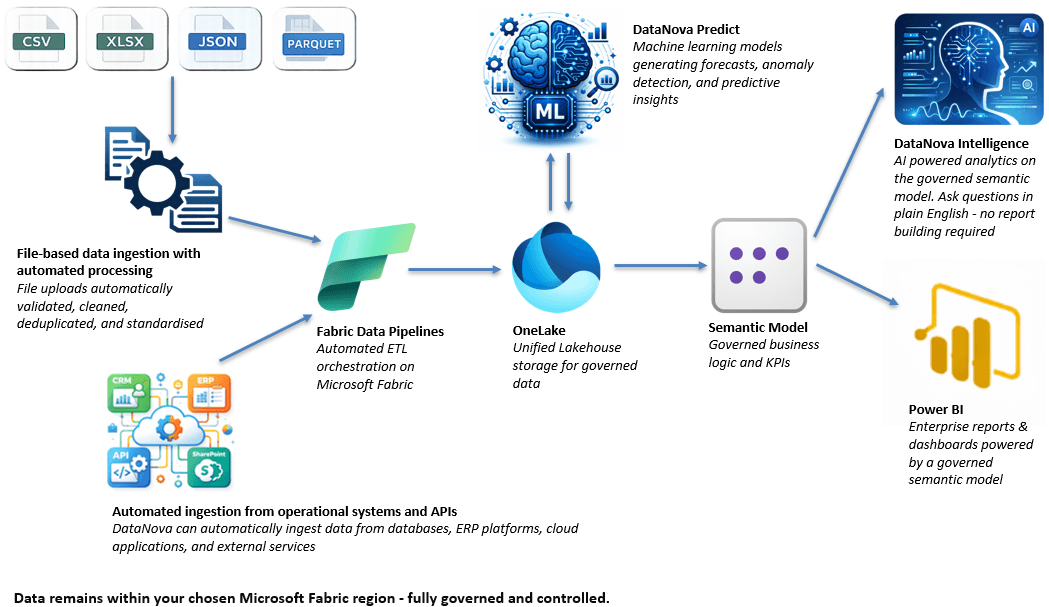
Instead of emailing spreadsheets around the organisation, teams can use controlled forms to submit data in a structured way. That information can then feed into the lakehouse, semantic model, and Power BI dashboards.
This turns reporting from a passive experience into an active one.
Users do not just view performance. They can contribute inputs, update assumptions, and support business workflows in a controlled way.
For example, a finance team could collect budget figures through a form, store them in the lakehouse, and compare them against actuals in Power BI. Operations teams could submit weekly performance updates that flow directly into dashboards. Managers could provide forecast adjustments without sending spreadsheet versions back and forth.
Data apps help bridge the gap between reporting and action.
They allow organisations to keep the flexibility of business input processes while improving governance, structure, and reporting accuracy.
With DataNova, dashboards are only part of the platform. The wider opportunity is helping teams manage the data processes that sit behind better decisions.