


AI is changing how businesses interact with data.
Instead of only clicking through dashboards, users increasingly want to ask questions, generate summaries, explain trends, and receive automated insights.
This creates a major opportunity. But it also creates a major risk.
If AI tools are connected directly to raw, unstructured, or poorly governed data, the answers may be inconsistent, inaccurate, or difficult to audit.
That is why semantic models matter.
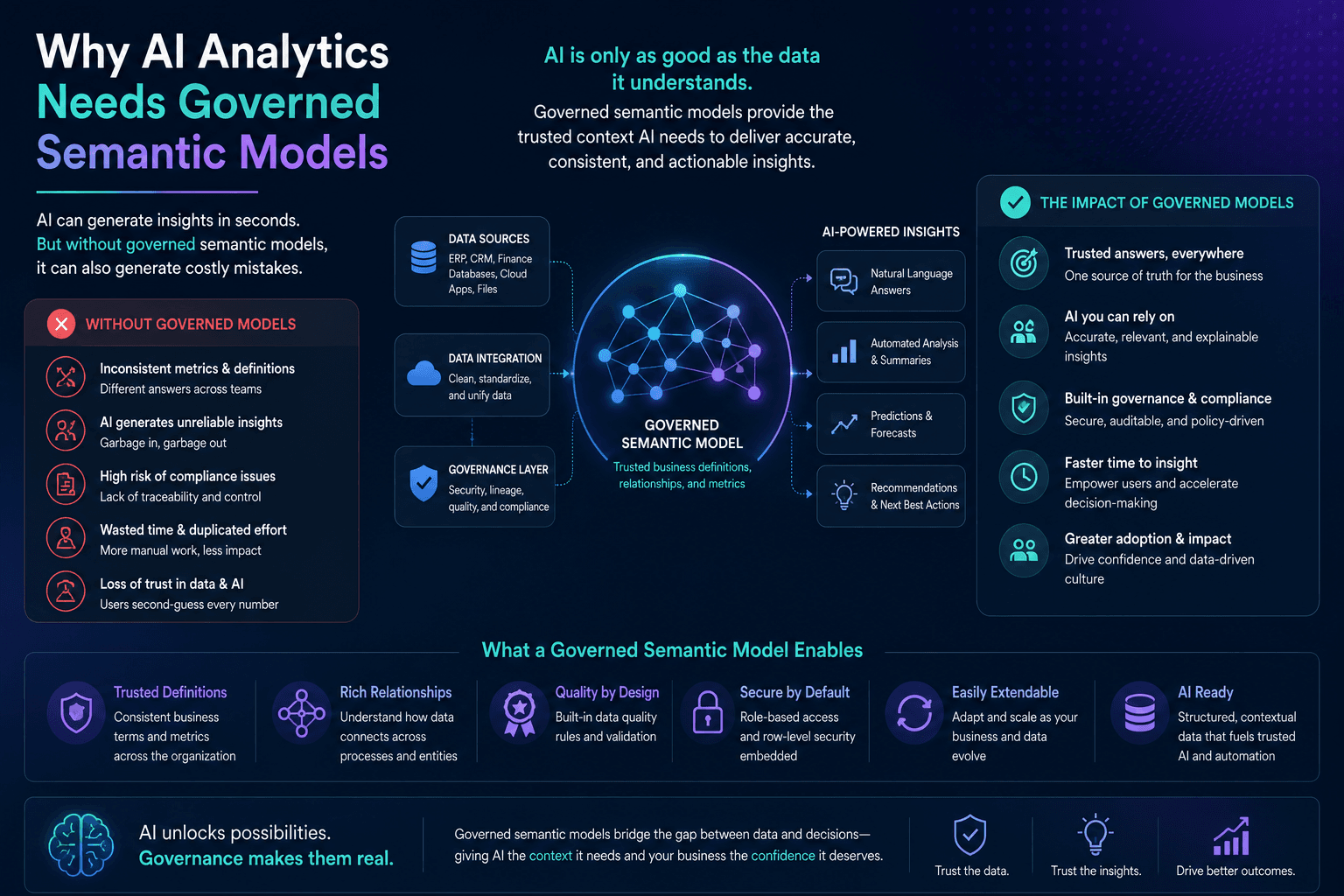
A semantic model acts as the business logic layer between raw data and reporting. It defines how KPIs are calculated, how tables relate to each other, and how users should interpret key metrics.
For example, different teams may define revenue, margin, active customers, or pipeline value in different ways. Without a governed semantic model, AI tools may produce answers that conflict with official reporting.
Governed semantic models help ensure that AI analytics is based on trusted definitions.
They support:
- Consistent KPI calculations
- Controlled business logic
- Better data governance
- Stronger auditability
- Safer AI-generated responses
- Alignment with existing Power BI reports
DataNova’s approach to AI analytics is built around controlled access.
Rather than allowing AI tools to interact freely with raw databases, DataNova enables AI-assisted insights through governed reporting structures. This helps users benefit from AI while keeping outputs aligned with approved business definitions.
The goal is not just to make AI available.
The goal is to make AI useful, secure, and trustworthy.
AI can help users understand dashboards faster, generate narratives, explain movements, and highlight areas that need attention. But for those insights to be reliable, the data foundation must be governed.
In analytics, AI is only as strong as the model behind it.
With DataNova, organisations can explore AI-powered insights while keeping governance, security, and trust at the centre of the reporting process.