



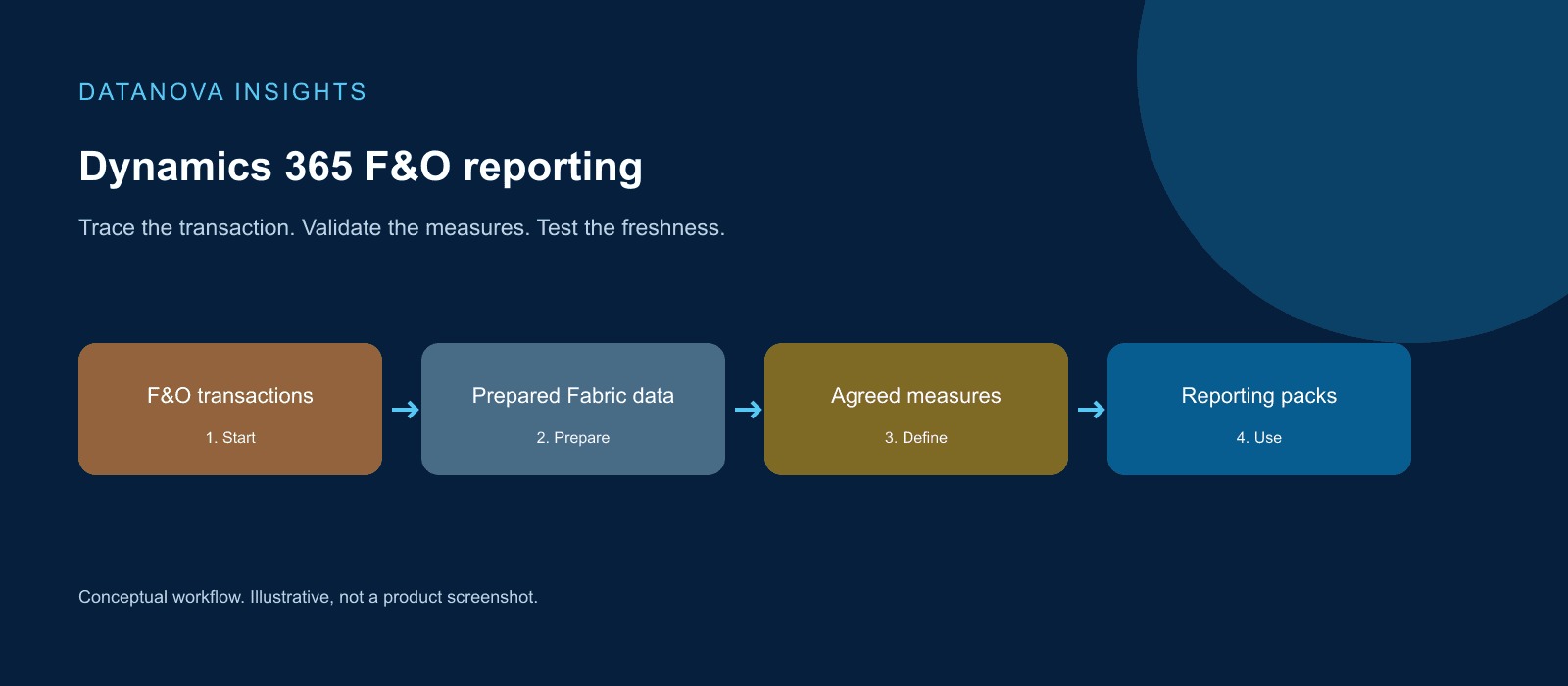
A useful Dynamics 365 Finance and Operations reporting pack connects a defined business decision to reconciled data, agreed measures and a clear owner. A collection of attractive dashboards is only part of the deliverable. Start with the questions your finance and operations teams repeatedly answer, then agree the data, freshness and acceptance tests behind each one.
Why standard reports do not settle every question
The ERP is where transactions happen. Management questions often cross the boundaries of modules, companies and other systems. A finance director may want to compare the receivables position with disputed invoices and the sales pipeline. An operations manager may need stock availability alongside outstanding orders and shipping exceptions.
Exporting each source to Excel can solve today's question. Repeating that exercise creates a reporting process dependent on individual workbooks, manual joins and private definitions. The opportunity is to make those decisions repeatable without pretending every business uses the same accounting rules.
Scope packs around the work people actually do
- General ledger: trial balance, financial statements and actual-versus-budget views, with approved account mappings and reporting periods.
- Accounts payable: outstanding liabilities, payment timing and supplier exposure, with agreed treatment of credits and disputes.
- Accounts receivable: ageing, collections priorities and overdue balances, with explicit due-date and currency rules.
- Stock and fulfilment: inventory, order progress and shipping exceptions, scoped to the source tables and operational events available.
For each pack, nominate a business owner and a reference report. Agree what should reconcile, at which grain and at what point in time. This is more useful than approving a long list of chart types.
Use a prepared foundation, then adapt the definitions
A prepared pack gives the project a starting structure. It should still accommodate legal entities, fiscal calendars, dimensions and custom fields. Microsoft describes bronze, silver and gold layers as a progression from raw to curated data. In a reporting project, that separation helps make transformations inspectable. See Microsoft's medallion architecture guidance.
As an illustrative acceptance test, take one posted invoice through the pipeline. Confirm its company, currency, amount, due date and settlement status in the report. Repeat with a credit note, a partial payment and a period boundary. Passing those cases is stronger evidence than a total that happens to look plausible.