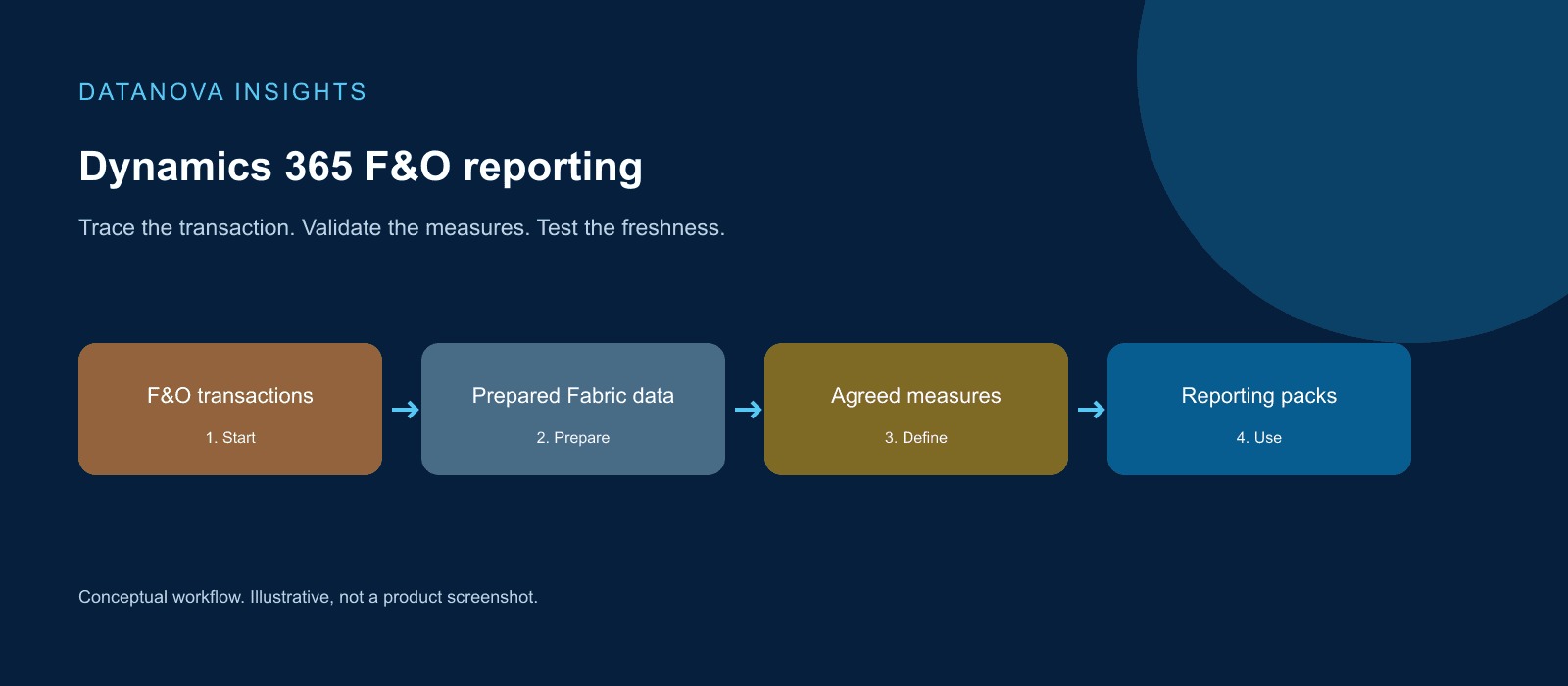




Better Business Central reporting needs both timely data and consistent definitions. A faster feed will not settle a disagreement about revenue recognition, overdue debt or inventory valuation. Choose the reporting questions first, validate the connection route, then test the numbers and the end-to-end delay together.
The recurring problem is the handover between systems
Business Central records the transaction. The management pack may also depend on a budget workbook, sales targets or operational data elsewhere. Someone exports, maps and combines those sources before a meeting. If that person is unavailable, the process slows down. If their mapping changes, the next report may describe a different business.
A shared reporting foundation makes those choices visible. Which companies are included? Is the report using local or reporting currency? What does an open order mean? Who approves the account mapping? These questions belong in the implementation scope, rather than in a footnote after the dashboards are built.
What a useful first reporting pack includes
Begin with a coherent finance scope: GL and financial statements, AP, AR and cash visibility. Add stock, purchasing, sales or fulfilment where the source data and business need justify them. Confirm the history needed for trends and the dimensions used for responsibility reporting. Avoid collecting every available table simply because the connection can expose it.
For example, a collections view should separate an overdue invoice from a customer credit and show the agreed treatment of disputed items. This is an illustrative design test, not a claim about a particular customer's results. Finance should be able to trace a displayed balance back to the expected source entries.
Mirroring is promising, but check its availability
Microsoft's current Business Central mirroring documentation is prerelease. It describes replication from selected companies and tables into an open mirrored database in Fabric, and warns that timing and functionality may change. Check the current Business Central mirroring documentation before making it a dependency.
The mirroring FAQ also distinguishes an initial historical synchronisation from subsequent incremental changes. Eligibility, environment version and the available feature state must be confirmed for the client's tenant. A connection demonstrated elsewhere does not prove that it is available for your production environment.