

Triage the reported issue
Capture the asset context and decide whether a request needs authorised work.
Prepare a maintenance request and work-order app for triage, assignment, checklists and cost tracking, connected to asset and operations reporting on Microsoft Fabric.
Prepared with you.Your rules, roles and setup agreed before the trial.
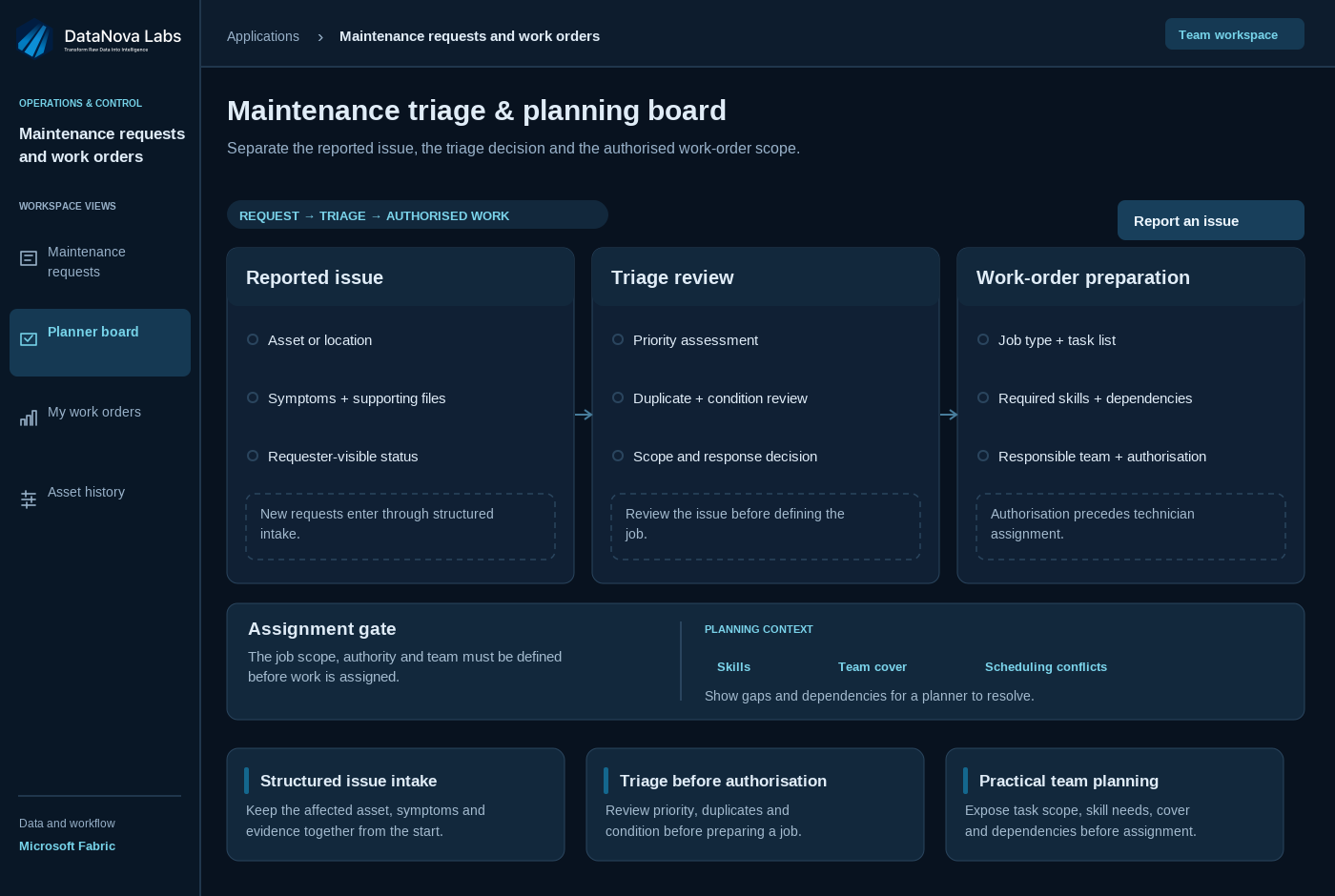
A maintenance request and work-order app captures asset or site issues, supports triage and assigns authorised work. It records the technician's findings, tasks, evidence and completion review against the relevant asset.
A request, an authorised work order and a verified completion are different stages. Design the handoffs so each person knows what they own.
Capture the asset context and decide whether a request needs authorised work.
Connect assignments with task checklists, work notes and supporting evidence.
Keep work completed separate from the review that closes the job.
The layouts show request triage, work preparation and checklist evidence. They focus on maintenance execution and completion review rather than a repeated dashboard. Your workspace is configured around your users, data and agreed workflow.
New issues, attachments and requester-visible progress.
Triage, priorities, work preparation and assignments.
Assigned jobs, checklists, work notes and evidence.
Completed work, recurring issues and agreed cost measures.
Use this as the scope checklist for a practical build. We confirm what can be reused, what needs configuration and what needs development before implementation.
Capture the affected asset or location, symptoms, priority and supporting files. Give requesters a clear status without exposing restricted maintenance details.
Review duplicate requests, priority, asset condition and the appropriate response. A request is not automatically an approved work order.
Define the job type, task list, required skills, planned dates and responsible team. Record dependencies and the basis for authorisation.
Assign work to permitted technicians or teams and record acceptance, progress and reassignment. Surface missing cover or scheduling conflicts.
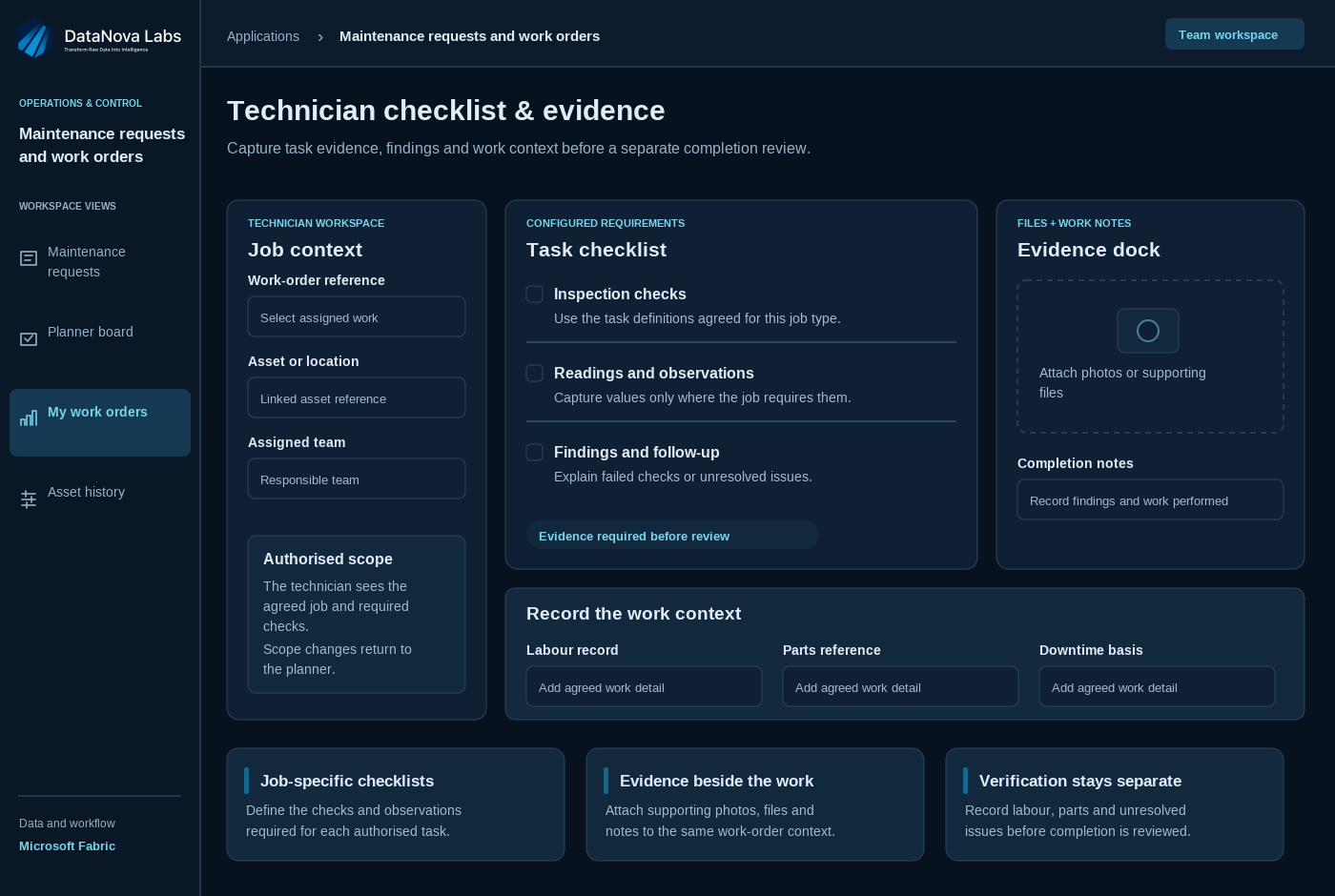
Capture the agreed checks, readings, photos and completion notes. Require the relevant evidence before a job can move to review.
Record time, planned or used parts and downtime using agreed definitions. Reconcile costs against connected operational records where available.
Separate work finished from work verified. Record failed checks, unresolved issues, follow-on jobs and controlled reopening.
Review request and work history by asset, site and job type, with ownership, change history and permission-controlled evidence.
Describe the issue and the affected asset or location.
Confirm priority, scope and whether a work order is needed.
Assign authorised tasks and capture the work evidence.
Review completion and record follow-up actions.
Returns, rejections, cancellations and corrections follow the rules agreed for your process. Each decision retains its owner, reason and relevant record version.
These are implementation requirements to agree and verify, rather than a claim of certification or automatic compliance.
Define record and field access by role, entity, department or project. Separate preparation, approval, administration and export rights, with server-side enforcement.
Agree thresholds, approval stages, delegated cover and escalation. Retain actor, time, reason and the version reviewed, including returns and resubmissions.
Agree file types, size limits, malware handling, document access and retention. Validate imports and show rejected rows instead of silently losing information.
Keep failed notifications, blocked tasks and integration errors in owned queues. Control retries and overrides, then reconcile the actual downstream outcome.
Agree the first workflow and prove it against your acceptance criteria. Add connections or specialist capability when the source systems and controls are ready.
The app does not certify equipment safety or replace trained inspection, permits or statutory maintenance duties. Safety-critical decisions and specialist asset controls require the appropriate qualified process.
For each connection, we verify source access, API capability, licensing, mappings, update frequency and failure handling. Hosting, identity, document storage, retention and any external-user requirements are confirmed during design. Integration names do not imply a prebuilt connector.
Share your requirements. No card or commitment.
Describe the result you need and the information you work with. We can help you identify a suitable existing application or scope a tailored pilot.
A card is required when you start a trial. An enquiry does not start a subscription or commit you to a project.
Both assisted routes include a 30 day free trial, starting after onboarding and environment setup. Card required at signup. No charge until your 30 day trial ends.
If an existing application meets your requirements without additional mapping or implementation, implementation and the 30 day trial are free. Normal subscription charges begin after the trial, under your agreed terms.
We agree the application, mapping, workflows and implementation quote upfront. We then prepare the agreed pilot for your 30 day free trial. If you choose to proceed afterwards, the quoted implementation fee and monthly subscription become payable.
We confirm the pilot deliverables, preparation, trial start and decision process together. Any work beyond the agreed pilot scope is discussed separately.
Clear scope, controlled data and a trial route agreed with you.
Microsoft Fabric Apps availabilityA request reports a need or issue. Triage determines its priority and response. A work order defines the authorised job, assignee, tasks and evidence required for completion.
Preventive plans can be scoped around approved calendar or meter rules. The asset history, source readings, intervals and missed-work handling must be agreed and validated.
Yes, those can be included in the configured task form, with agreed file controls, access and labour definitions. Offline use and native device functions require separate design.
The core offer is requests, work orders and maintenance history. Predictions from sensor or failure data are an optional modelling project with separate data and evaluation requirements.
This is a configured application offer, not an app automatically enabled at signup. We agree the fields, workflow, permissions, source data, hosting and acceptance checks first. Existing fit, configuration and custom development are confirmed before your assisted trial.
Fabric can connect the data and reporting foundation. DataNova designs and implements the app interface, validation, workflow and access controls. Microsoft's native Fabric Apps capability is currently in preview; where it is considered, we verify tenant enablement, regional availability, capacity, authentication and suitability. Complex transactions or external access may require a different agreed application architecture.
We review the process, source access, users, controls and required connections, then separate the app scope, implementation, platform or capacity costs and optional integrations in the quote. We also agree onboarding, support ownership, service hours and escalation routes. The existing assisted-trial terms apply after onboarding and environment setup.